
Message from the Board Chairperson
The economy and country faced challenges in 2025
Cambodia’s economy in 2025 showed resilience amid a period of global and regional uncertainty. While the economy continued to expand by around 5%, it was negatively impacted by to the border conflict with Thailand, the tariffs imposed by the US and a diminished global demand for garments, tourism and agriculture produce.
Despite efforts to resolve the border conflict with Thailand the skirmishes developed into battles with thousands of Cambodian residents being displaced, resulting in much less tourism in the affected regions and a large contingent of Cambodian migrant workers was not able to remit funds to their families any more. First Finance is concerned about these developments and where possible helps the people in those regions but fortunately not many of its clients were impacted.
Financial sector facing reduced growth and higher risks
While the financial sector grew fast in previous years it now faces some significant challenges, one being the much higher NPL rates across the board and another being the property sector because too many houses in new large developments have been built while the demand is still relatively small and risks for the institutions financing property developers and end-buyers are relatively high. As there is not yet a mature second hand housing market, collateral values have limited mitigating impact on credit risks to banks. Loan restructuring continues to be offered to eligible borrowers but this will not necessarily reduce their risk profile because generally income levels of many families have reduced. First Finance operates in the affordable housing sector which is the least impacted segment of the real estate sector, however it still faces challenges from restructured loans to families whose cash income has reduced and several loans that were originated in the past through property developers are still in default.
Microfinance and affordable housing continues to offer a large opportunity
The microfinance sector continues to play a critical role in supporting inclusive economic development in Cambodia and, excluding microfinance portfolios of banks that recently converted from being a MFI, serves 1.5 million borrowers and maintains a loan portfolio of US$ 6.5 billion. This underscoring the sector’s importance in extending credit to households and small businesses that remain underserved by traditional banking institutions.
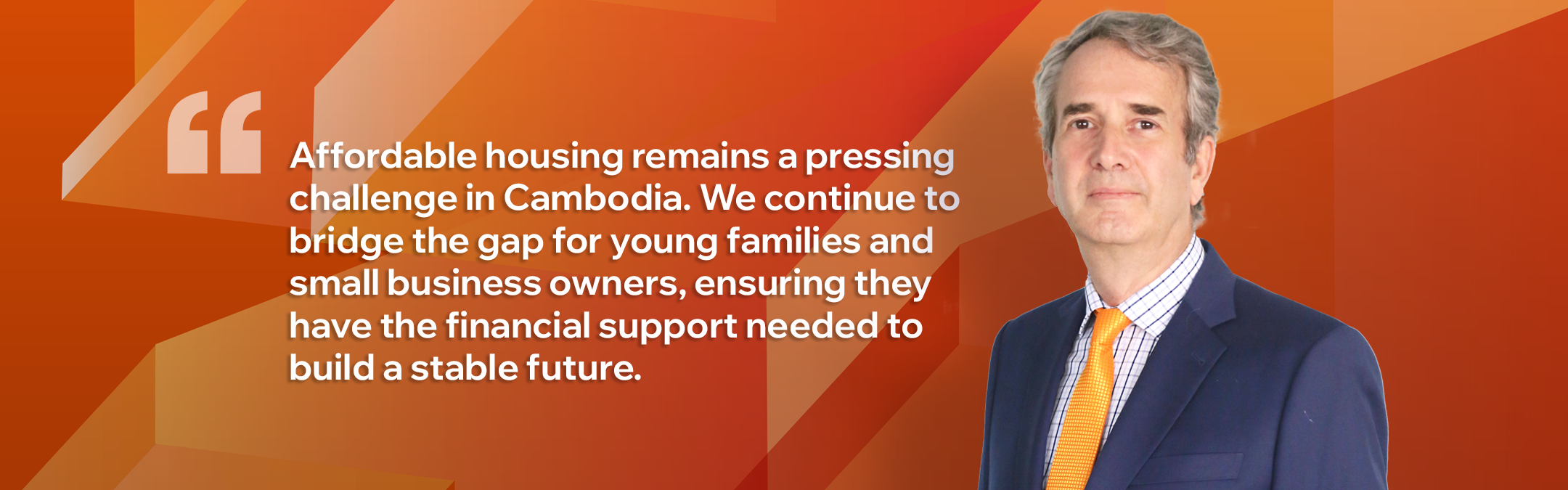
Affordable housing remains one of the most pressing development challenges in Cambodia’s rapidly urbanizing economy. The fast growing population with a large young demography, many of whom wanting to start a family and move to Phnom Penh, have limited access to long-term housing finance. This continues to create a significant gap between demand and supply in the affordable housing segment which shows that the coming years will still offer a large market opportunity for First Finance.
Solid performance in 2025
The Board of Directors was delighted to see that Management successfully expanded the business during 2025 by opening 6 new branches, serving around 12,000 customers, most of them low income earning families who have their own small business, and growing the portfolio to US$ 100 Million. Reaching this portfolio size is a significant milestone in our 16 year of operations.
Management continued its strong focus on risk management, ESG objectives, digital innovation and especially on customer service, and proved that it successfully adjusts and improves its business model to keep the right balance between portfolio growth and risk control.
Considering that during 2025 the economy was challenged by serious macro events and that several other MFIs, some already converted to a commercial bank, were not able to grow their business much, this achievement by First Finance was impressive and laid a good foundation for continuing success going forward.
Outlook for 2026 optimistic
Looking ahead to 2026, Cambodia’s outlook remains cautiously optimistic. Economic growth is expected to stabilize as structural reforms, continued foreign investment, and the gradual recovery of tourism will support domestic demand. While risks remain, such as the higher credit risk levels and the oversupply in the real estate sector, as well as international trade suffering from regional and global challenges, the country’s strong fundamentals position it well for modest economic growth during 2026.
On behalf of the Board of Directors I would like to thank all our staff and management team, our client-families, our funding partners and NBC for their continuing support and to wish First Finance a successful 2026!